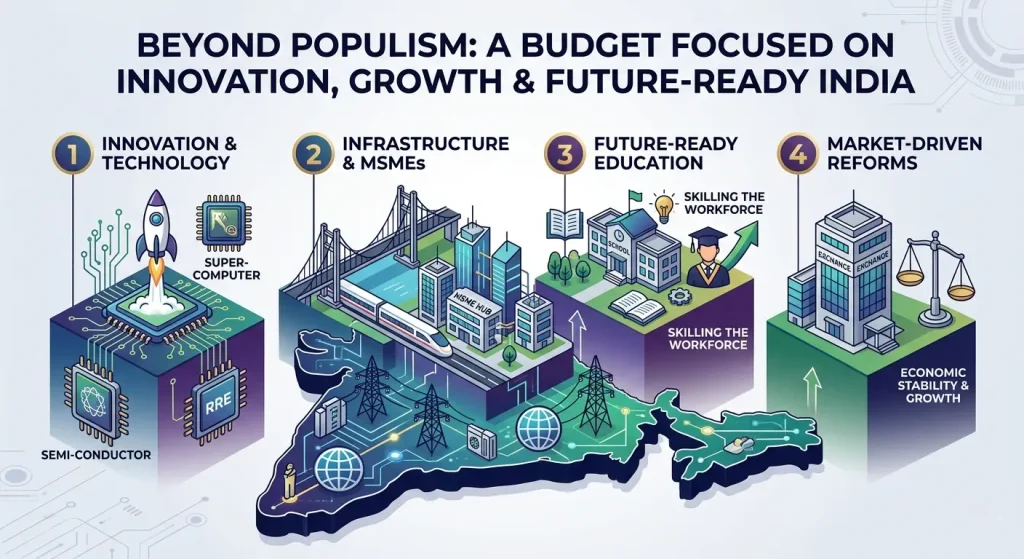
Amidst global economic tailwinds, this budget is risk ready, innovation friendly and focused on accelerating employment-led development. It effectively deploys fiscal and soft power tools,while making decisive investments in new age sectors and India’s youth population, which is India’s mitochondria. This budget confidently speaks the language of the future highlighting rare earth minerals, nuclear energy, semiconductors, data centres and artificial intelligence which are critical drivers of the future economy strengthening the global positioning. Given that this is not an election year, the budget clearly avoids a populist tone.
As the Finance Minister delivered her ninth consecutive budget, her continued focus on youth, women, and divyangjan is welcome. This budget is all inclusive, broad based and balanced across regions and sectors unlike last year’s budget promoting various sectors and regions in all spheres be it manufacturing, services and farmers economy in an appropriate ratio. India, at this stage of development, needs creation of new talent, skills and capital formation. Terming it as a reform express, the government highlighted over 350 reforms undertaken during its tenure in power. The budget incites deregulation but does not clearly define the sectors chosen.
Most importantly, a particular significant development is to provide a serious push on rare earths. The global supply chain for rare earth is dominated by China, controlling the majority of mining, processing, and magnet production, giving it significant geopolitical leverage. In response the United States and its allies have increasingly focused on diversifying their supply sources, investing in domestic mining projects, and developing advanced processing technologies to build resilient, sovereign supply chains, given the strategic importance of these elements in defense, clean energy, and high-tech industries. This budget promotes creation of dedicated rare earth corridors in mineral states of Odisha, Kerala, Andhra Pradesh and Tamil Nadu. Focus on mining, processing, research and development (R&D) and manufacturing will help us compete with global counterparts and play a critical role in the country’s long-term growth story. The announcement of Semiconductor Mission 2.0, with an emphasis on industry-led research and growth will improve India Stack and further India’s intellectual property ecosystem.
The focus on urbanisation and creation of city economic regions is forward looking and much needed. This approach will give renewed focus on Tier II and Tier III cities as well as temple towns helping growth to be more decentralised and development of new cultural and economical hotspots. Encouragingly, the Budget also recognises emerging and often areas such as mental health and trauma, the care economy, content creators, and the preservation of India’s culture and heritage—priorities that are both timely and essential.
The budget’s emphasis on education and skill development is evident through proposals like supporting states in establishing five university townships along major industrial and logistics corridors. These are envisioned as integrated academic zones and skill hubs, aiming to bridge the gap between industry requirements and academic output. Furthermore, higher education will receive a boost with a focus on STEM, viability gap funding or capital funding, and a commitment to establishing one girls’ hostel in each district to promote female enrollment. In a move to advance scientific research, the budget allocates resources to astrophysics and astronomy, including the development of new telescope facilities and the National Large Solar Telescope, positioning India at the forefront of advanced space and scientific research.
The focus on the Tourism sector is multi-pronged, aiming to enhance employment opportunities, boost foreign exchange earnings, and strengthen the local economy. A key initiative is the upgrading of an existing institution to establish the National Institute of Hospitality. To improve tourist experience, a pilot scheme for upskilling 10,000 guides in 20 iconic sites, potentially in collaboration with institutions like IIMs, has been announced. The ‘National Digital Knowledge Grid’ will digitally document all places of cultural, spiritual, and heritage significance, creating jobs for researchers, content creators, and historians. Adventure tourism is set to be promoted through the development of trekking and hiking in regions of Himachal Pradesh, Uttarakhand, and Jammu & Kashmir, as well as the Arakku Valley in the Eastern Ghats and Pudikomalli in the Western Ghats. Heritage and culture tourism will see the development of 15 prominent sites into vibrant experiential centers featuring immersive storytelling and interpretation centers. With continued support to Khelo India Mission and training of coaches and support staff, India’s sports ecosystem is set to expand, with youth at the centre of this transformation.
For India Inc, the Budget has been largely positive, with a well-defined focus across multiple sectors and industries both in manufacturing and service sector. The government has clearly reiterated its confidence in MSMEs, which remain the true backbone of India’s growth story. Measures such as dedicated freight corridors, continued emphasis on capital expenditure, and incentivisation of the services sector through broad-based and stable safe harbour rules collectively support both the manufacturing and services economy.
A major talk of the town is the proposal to constitute a high-powered committee to review the Banking industry in the country in light of reform-led growth. This signals the government’s intent towards large-scale restructuring of the banking ecosystem—an initiative that is expected to unfold significantly in the near foreseeable future.
On the taxation front, most major reforms have already been implemented over the past year both in direct taxes in the form of New Income tax Act set to be effective from April 01 2026 and GST reforms of September 2025, and therefore no major surprises were witnessed in this Budget. Procedural relaxations and decrease in TDS/TCS rates are a welcome step. The rollback of the earlier buyback tax treatment deserves appreciation, reflecting the government’s willingness to listen to the concerns of smaller participants in the capital markets. However, the simultaneous increase in Securities Transaction Tax (STT) may act as a deterrent for foreign portfolio flows and is likely to impact high frequency trading volumes, particularly affecting the brokerage industry. The extension of specific tax holidays for data centres until 2047 underscores the growing importance of this sunrise sector and reinforces the government’s long-term commitment to capacity building in digital infrastructure.
From a macroeconomic perspective, both capital expenditure and government borrowings have increased compared to the previous year, reflecting the government’s continued emphasis on growth-driven public investment. However, the rise in sovereign borrowing alongside the stated commitment to developing the bond market appears somewhat contradictory. Several states continue on an aggressive borrowing path, often deploying funds towards freebie-driven expenditure rather than productive assets. This, in turn, pushes up yields and raises the cost of private-sector borrowing, constraining credit flow and limiting the healthy development of the bond market.
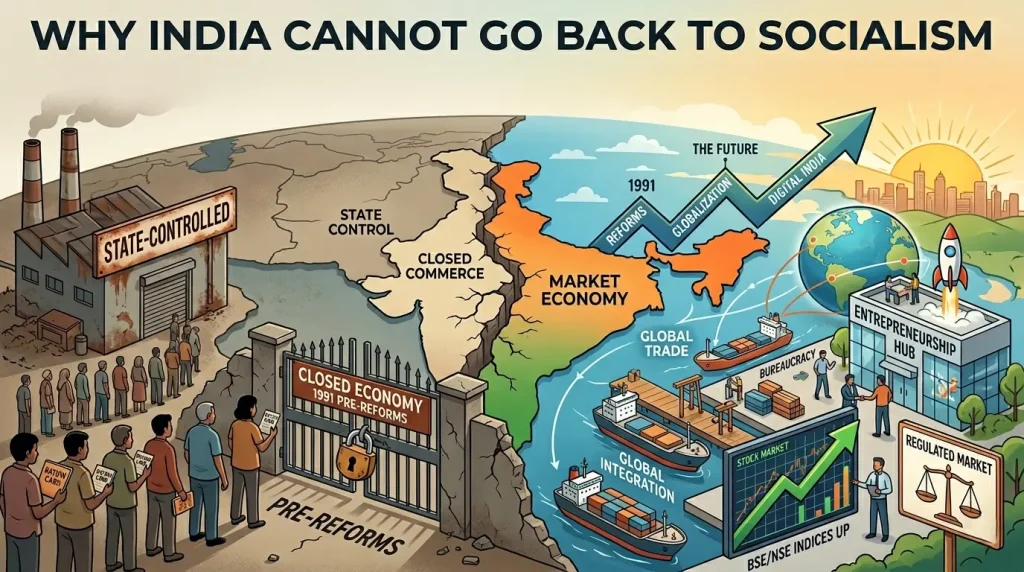
Overall, the Budget marks a decisive shift in India’s economic philosophy. The government appears to have moved away from traditional socialism and, without fully embracing pure capitalism, has adopted a pragmatic middle path centred on marketism. The emphasis on future-ready sectors, institutional reforms, and long-term capacity building signals strategic intent rather than short-term political messaging. However, for this vision to fully translate into outcomes, it must be complemented by fiscal discipline at the state level, responsible borrowing, and deeper financial market reforms—particularly in bond markets. If executed cohesively, this market-oriented approach in sync with capital expenditure and consumerism has the potential to deliver durable growth, strengthen India’s global competitiveness, and position the economy confidently for the next phase of development.
(The authors are Directors, Arth Vidhi)