
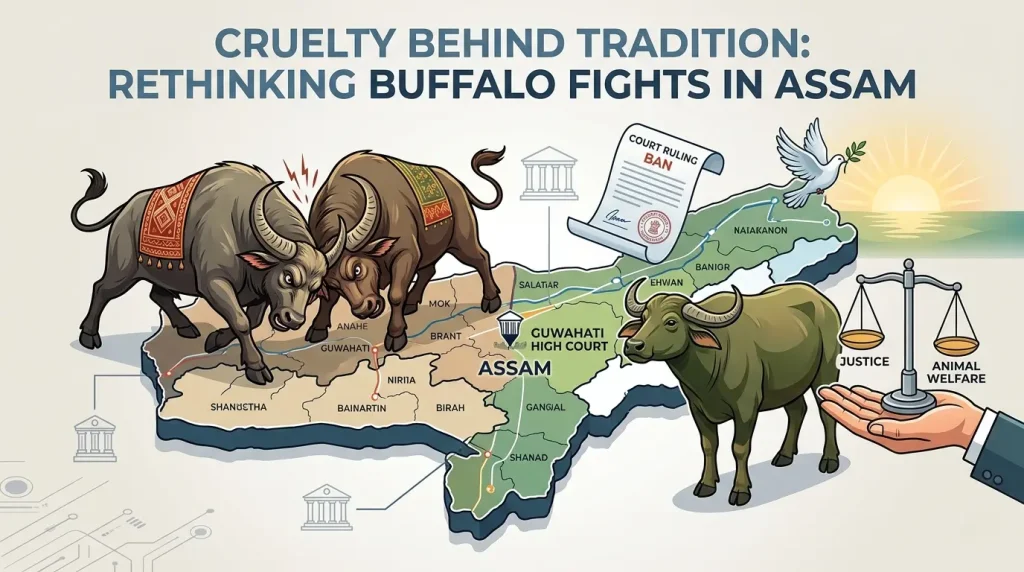
Gauhati HC bans buffalo fights, terming the practice cruelty violating animal protection laws.
Picture this. It is January in Assam. The air smells of ‘tilorlaru’, and the sound of dhol fills the morning. Families have gathered to celebrate the harvest. And in an open field, a buffalo – its nose roped, terrified, bleeding from fresh wounds – is beaten with a thick stick and forced to charge at another animal. The crowd cheers. This is Moh-Juj, or buffalo fight, long presented as culture, tradition, and heritage.
On April 21, 2026, the Hon’ble Gauhati High Court examined evidence submitted by PETA India, including photographs and videos of open wounds and visible distress. The Court held clearly that this is not culture – it is cruelty inflicted upon innocent animals, directly violating the Prevention of Cruelty to Animals Act and prior judicial directives. Acting on a writ petition filed by PETA India over illegal buffalo fights held across Assam in January, the Court ordered the state government to immediately ban the practice and take strict action against organisers. This was not the first time. In December 2024, the same Court had struck down an Assam government rule permitting buffalo fights during Magh Bihu. Despite that ruling, the fights happened again in January 2026, openly, with no consequences.
Behind the ruling stands the Supreme Court’s landmark judgment in Animal Welfare Board of India v. A. Nagaraja(2014), which recognised animals as sentient beings capable of pain and fear, and affirmed that constitutional protections extend to the voiceless. The law has always been there. What was missing was the will to enforce it.
For a nation that embeds compassion within its constitutional and moral fabric, this failure of will is difficult to justify. India’s ethos rests on ahimsa and karuna – principles that call for respect for all living beings. Mahatma Gandhi reminded us that a nation’s greatness is reflected in how it treats its animals. Article 51A(g) of the Constitution makes compassion for all living creatures a fundamental duty of every citizen.
Yet consider the buffalo, roped by the nose, beaten into a rage, forced to fight another terrified animal. Is that animal experiencing our ahimsa? The contradiction between what we claim to stand for and what we allow to continue is stark.
This tension is not unique to India. Argentina, Canada, Cuba, Denmark, and several regions of Spain have moved to ban bullfighting entirely, driven by declining public support. In none of these cases did cultural identity disappear. It simply evolved – and in evolving, grew stronger – because it shed what could no longer be defended.
A court order alone will not end buffalo fights. Enforcement and meaningful alternatives are both essential. District-level animal welfare teams must be constituted before every festival season. Bihu dance competitions, food festivals, local craft markets, and folk music events can keep the spirit of Magh Bihu fully alive without harm to any living being. For communities where the ritual feels irreplaceable, pilot programmes using life-sized animatronic animals, already proposed by welfare organisations in Kerala, offer a transitional bridge worth exploring. Village councils that voluntarily redesign their festivals should receive financial support, because reform works better with incentives than with penalties alone. Finally, Assam needs a stronger state-level Animal Welfare Act – one with higher penalties, faster prosecution, and enforcement officers held clearly accountable.
Laws change slowly. Attitudes change even more slowly. But history has always shown us – they do change. Not because governments woke up one morning with a conscience but because ordinary people refused to look away and kept asking uncomfortable questions until the room could no longer pretend not to hear. If you are a lawyer, the tools are already in your hands – use them. If you are an activist, build bridges with communities, not just battles against practices. And it is the responsibility of the government to act as guardian for the voiceless. A buffalo does not understand court orders. It does not know about the Constitution, or ahimsa, or Article 51A. It can only feel the pain, the fear, and the rope around its nose. Our values must extend to those who cannot speak them.
(The author is assistant professor, Asian Law College, Noida.)