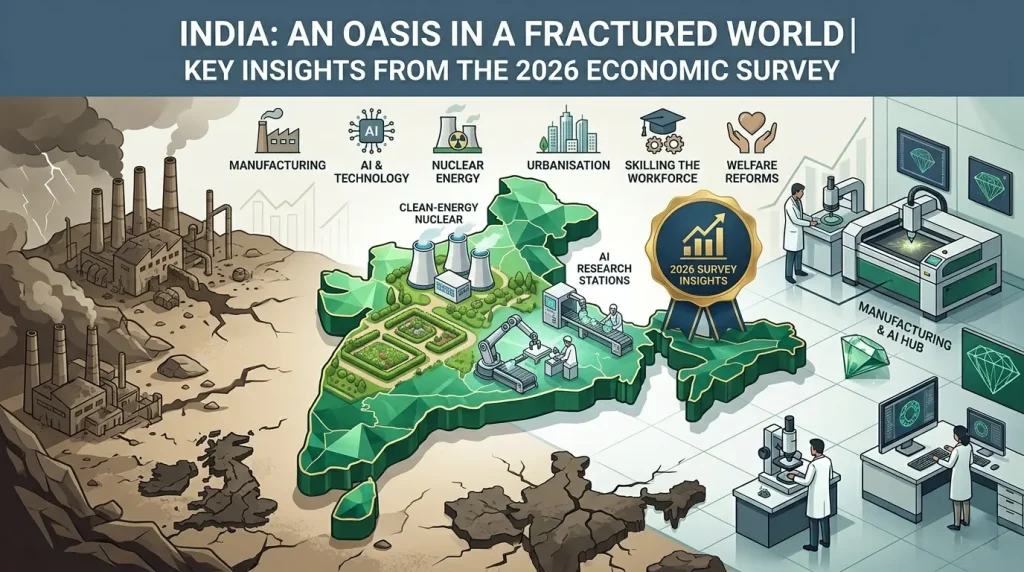
India has truly been an oasis of economic performance in the global scenario. We recently signed ‘mother of all deals’, i.e., India-EU Free Trade Agreement, and also negotiated around seven such deals with other nations in last 5 years, and eight others are under negotiation. While this sends an important signal to distorted global order, let us look at the recently launched Economic Survey 2025-26 by our Chief Economic Adviser (CEA). An Economic Survey is a document to look back, on our finances, on our growth and on our fiscal vision for the upcoming year. This year, we are back to basics – manufacturing, MSMEs and skilling. But also looking forward to urbanization, AI and nuclear.
We will continue to be world’s fastest growing economy with GDP growth rate projected to be 6.8-7.2%. From Covid year FY21’s fiscal deficit of 9.2%, we have come down to nearly half at 4.4% this FY26. How could we do this? By increasing tax buoyancy and improving quality of expenditure (capital expenditure). Rupee is not at its best health, but it will improve as we would have better forex reserves. The flow of resources to the commercial sector has been positive, which should be the focus as private players march towards investments in the economy. We need to generate more investor interest and export earnings.
Speaking of social sectors like healthcare and education, we are improving but there are also good gaps to fulfill. The Survey says that 81% of rural households have tap water, it should be 100% in next 5 years or so. We are a big nation, and big enough to be noticed for our poverty and economic status. While we strike big deals, it is important to take care of our population across our nook and corner. Through housing and credit schemes too, social welfare is working in favour of our people, which is welcome. In healthcare sector, response on the U-win portal have been positive for immunizing our population; the Survey also highlights success of Ayushman Bharat programme. Interestingly, it also mentions banning of online gaming in healthcare chapter, as CEA spoke that online gaming affects mental health of our population. In education, focus is on enrollment, inclusivity, equity and performance. A welcome move is 100% FDI in education sector and it is expected that 15 foreign institutions would set up a campus in India.
While there is debate nowadays on banning social media for children under 16, the Survey did mention safe internet guidelines for schools, focus on screen timing, online gaming regulations, online safety, mental health and related helplines, etc. which are forward looking initiatives.
Implementation of labour codes could result in creation of additional 77 lakh jobs for India, an SBI statistics shows, as per November 2025. This is interesting to see, that legal codification is also proportional to ease in doing business, and promoting employment opportunities. Welcome initiatives in industry and skilling includes, focus on care economy, Anganwadi centres, provision of creches etc. and promotion of women labour workforce amidst conventional taboo across various sectors. Increased urban mobility, women safety would encourage women workforce as well. Upgradation of 1000 ITIs shows that skilling is not a mere buzz word. Industrial skilling is going to improve the state of the economy and is a necessity rather than an alternative. Innovative financing models for skill development are also welcome.
Energy is a global debate. Every country is running after energy. It is a crucial time that we have decided to implead nuclear energy in our energy mix. Sustainable Harnessing and Advancement of Nuclear Energy for Transforming India (SHANTI) Act would promote nuclear energy as it is one of the cleanest forms of energy and would overcome issues of intermittency and energy security for us.
A separate chapter on Artificial Intelligence (AI) portrays government’s priority and curiosity to understand the trade-offs. One of the the trade-off, therefore, is between expending scarce resources to chase frontier-scale models or deploying those resources more effectively. My concern is that this chapter still debates on various policy choices that India has to take, and there is no clear position. On the other hand, countries like US, China have already dominated technologies, and AI models which we are yet to even adapt. Our technological push has to be pro-active and not reactive.
Urbanisation chapter also catches my eye. Making cities that are innovative and promotes design thinking, cities that inspire imagination is such a need. Imagine a city, where an individual is inspired to take a morning walk because the streets are clean, roads are smooth, and walls reflect the prowess of our great civilisation coupled with modernity. There is no mention of promoting civilisation though. Amidst all announcements, how do we solve the traffic jam problem in Delhi, Bangalore, Mumbai etc., that should be primary.
The other chapters mean what they are meant to be – statistics. The economic survey is a pre-budget document, that has shown us what the vision of government is, on fiscal side, which is promising but should not be a mere lip service.
(Aditya Trivedi is a practicing lawyer before Delhi High Court, and Founding Director, Arth Vidhi)