Over the past few years, the idea of the Orange Economy has moved from the margins of economic discussions to the centre of policy and planning. Creative industries: ranging from art, design, media, gaming, and digital content to heritage, culture, and innovation are now recognised as legitimate drivers of growth, employment, and global influence. The current budget’s focus on content creators and creative industries reflects this shift.
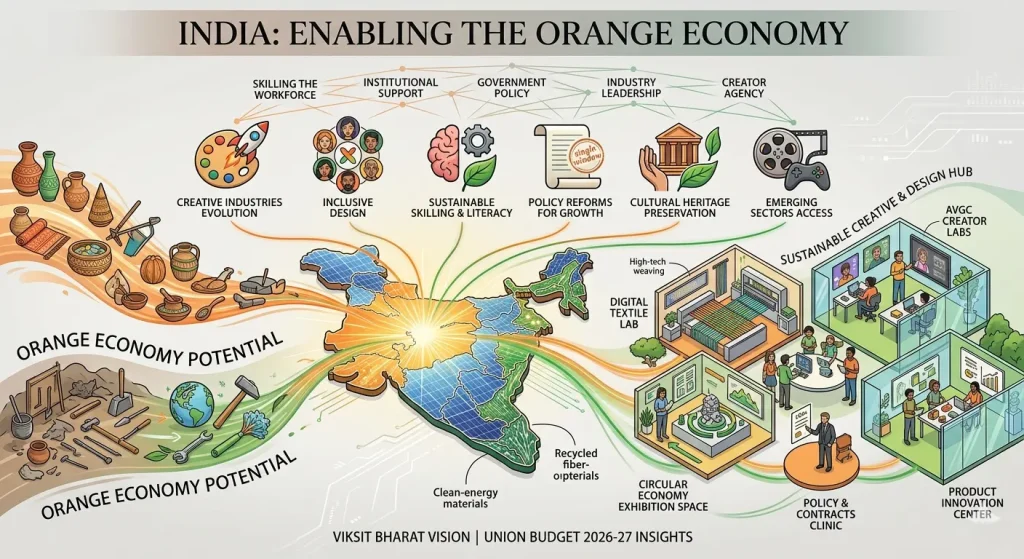
In fact, the Union Budget 2026–27 has formally positioned the Orange Economy as a key pillar within the vision of Viksit Bharat. It has recognised that economic value today increasingly flows not merely from physical goods, but from ideas, artistic expression, cultural capital, and intellectual property. The Budget has particularly emphasised high-growth sectors such as Animation, Visual Effects, Gaming and Comics (AVGC), noting that gaming revenues alone reached approximately ₹232 billion in 2024, while animation and VFX contributed around ₹103 billion. These are no longer niche sectors; they are emerging economic engines.
However, recognition alone is not enough. As the Orange Economy expands, the question before us is not only how fast it grows, but how sustainably it grows and who benefits from that growth. This is where leadership becomes critical.
Sustainable leadership, in today’s economy, requires a long-term perspective. It asks leaders to look beyond immediate returns and consider durability, inclusion, and resilience. In creative sectors, where work is often project-based, platform-driven, and informal, leadership must address both opportunity and vulnerability.
To understand sustainable leadership in the Orange Economy, we must first reflect on what sustainability means in this context.
Economic sustainability in creative industries begins with livelihoods. Many creators today face irregular income, unclear contractual terms, and limited access to formal financial systems. A sustainable creative economy is one where talent can build stable careers, not just temporary visibility. This requires fair remuneration, enforceable intellectual property rights, transparent revenue-sharing mechanisms, and access to markets beyond a single platform or trend.
Recognising this, the Union Budget 2026–27 has proposed structured institutional support for creative skilling. It has strengthened the Indian Institute of Creative Technologies (IICT) in Mumbai and proposed the establishment of AVGC content creator labs in 15,000 secondary schools and 500 colleges across the country. The objective is ambitious: to prepare nearly two million skilled professionals by 2030. Such measures acknowledge that talent development must begin early and must be geographically dispersed.
Social sustainability is equally important. Creativity flourishes in diversity. Sustainable leadership ensures that the Orange Economy does not become concentrated in a few urban centres or accessible only to those with financial security. It must include creators across regions, languages, genders, and social backgrounds. When participation is broad, culture becomes richer, and economic growth becomes more equitable.
In this context, the Budget has also proposed the establishment of a new National Institute of Design in eastern India, along with immersive digital storytelling initiatives at heritage sites and conservation laboratories. Additionally, the training of 10,000 tourist guides has been proposed to strengthen cultural tourism. These initiatives reflect an understanding that the Orange Economy is not limited to digital platforms; it extends to heritage, design, and regional cultural ecosystems.
Environmental sustainability, though often overlooked in creative sectors, is increasingly relevant. Digital production, large-scale events, and media infrastructure have environmental costs. Sustainable leadership involves adopting greener production practices, encouraging resource efficiency, and recognising that cultural growth cannot come at the cost of ecological responsibility.
These dimensions of sustainability place specific responsibilities on leaders across sectors.
For governments, the responsibility lies in enabling rather than over-regulating. Policy frameworks must protect creators’ rights while remaining flexible enough to accommodate innovation. The recent emphasis on skilling, creative education, and institutional support reflects an understanding that human capital is central to the Orange Economy. However, effective implementation will depend on whether these initiatives also equip creators with knowledge of contracts, intellectual property, and entrepreneurship, alongside technical skills.
The Budget has also proposed streamlining regulatory processes through single-window clearances for live events and concerts. This step aims to unlock the concert economy and reduce administrative bottlenecks that often discourage creative enterprises. Such measures demonstrate that sustainable leadership requires not only funding but procedural reform.
Public policy must also recognise the diversity of creators. A one-size-fits-all regulatory approach can unintentionally exclude smaller creators and startups. Proportionate regulation, simplified compliance processes, and accessible public support systems are essential for long-term sustainability. Equally important is policy continuity, so creators and investors can plan with confidence rather than uncertainty.
Industry leaders, including platforms, studios, agencies, and investors, carry a different but equally significant responsibility. They shape market conditions and set norms. Sustainable leadership in industry means moving away from purely extractive models toward partnership-based ecosystems. Transparent contracts, predictable payment structures, ethical data practices, and responsible use of algorithms contribute to trust and stability.
Industry also has a role in nurturing talent beyond metropolitan centres. Investment in regional hubs, mentorship programmes, and incubation initiatives can unlock creative potential that is currently underrepresented in the market. When industry looks beyond immediate scale and instead invests in depth and diversity, the entire ecosystem becomes stronger.
Cultural institutions and creative professionals themselves are also leaders in this ecosystem. Their responsibility is to maintain ethical standards in storytelling, protect cultural integrity, and ensure that communities are not reduced to content without consent or benefit. In an economy driven by narratives, leadership must be conscious of representation, attribution, and ownership.
This brings us to the role of young people.
Youth are not merely participants in the Orange Economy; they are among its primary drivers. Young creators are experimenting with new formats, redefining audiences, and challenging traditional business models. At the same time, they often face the greatest precarity.
Sustainable leadership requires creating pathways for meaningful collaboration between youth and industry. This includes structured apprenticeships, access to mentorship, and opportunities to learn both creative and commercial skills. The AVGC lab initiative across thousands of schools and colleges, if implemented effectively, can serve as a bridge between education and industry, ensuring that creative talent is not accidental but systematically nurtured.
For young people, leadership involves agency and awareness. Understanding one’s rights, valuing collaboration over competition, and recognising the long-term implications of creative choices are all part of building a sustainable career. Creativity thrives not only on talent, but on informed decision-making.
So, what does action look like?
It begins with education that integrates creativity with business literacy. It continues with financial systems that support small and independent creators. It includes investment in green infrastructure and digital public goods. And it depends on dialogue; between government and creators, between industry and youth, and between culture and commerce.
Sustainable leadership is not about controlling the Orange Economy. It is about stewarding it. It is about creating conditions in which creativity can grow without being exhausted, commodified, or excluded.
As we look ahead, the Orange Economy has the potential to contribute not only to economic output, but also to social cohesion, cultural confidence, and international engagement. With structured skilling, institutional investment, and regulatory facilitation as reflected in Budget 2026–27, India has signalled its intention to convert creative capital into a long-term growth engine. But this potential will be realised only if leadership remains thoughtful, inclusive, and grounded in long-term responsibility.
Every economy tells a story about what it values. An economy that invests in creativity signals that it values imagination, expression, and human potential. Sustainable leadership ensures that this story does not fade with time, but continues to evolve: responsibly, inclusively, and with purpose.
The choices made by leaders today will determine whether the Orange Economy becomes a lasting foundation for growth or a fleeting moment of opportunity. The task before us is to ensure it becomes the former: quietly, carefully, and collectively.